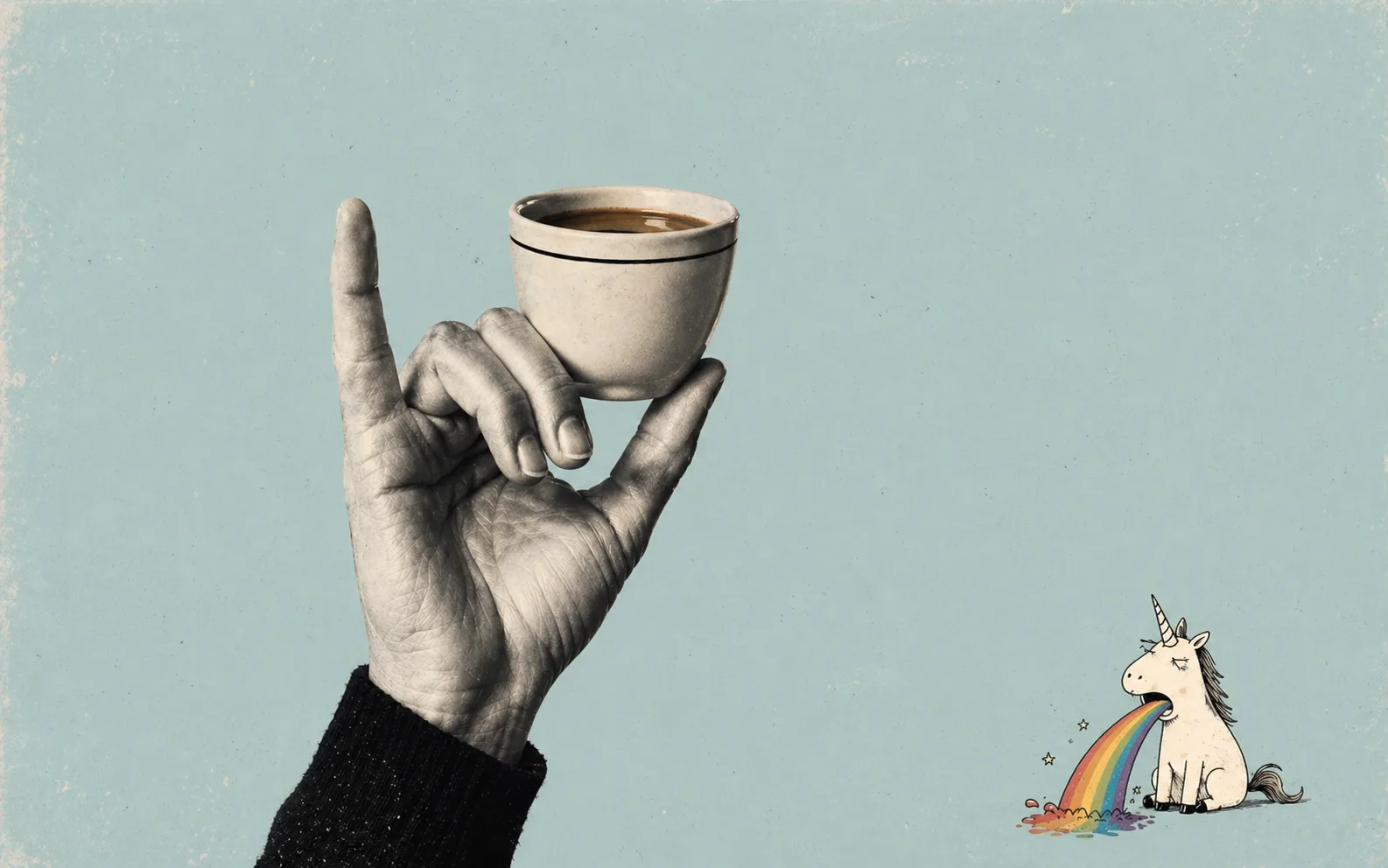
In February 2013 I wrote an article about coffee for Tasc, the magazine I was curating at the time.
I wrote it with the enthusiasm of someone who thinks he has found something interesting to tell, like when you discover a new bar and immediately need to explain it to everyone, even if nobody asked.
I talked about consumption data, trivia, latte art, a Japanese artist drawing on Starbucks cups. I quoted Toto and De Andre, and ended with the extremely elegant line: “You know what? I am going to drink a good coffee.”
It was nice, it was shallow, and it was probably the best I could write with what I knew then.
Thirteen years later I co-founded a printed zine about specialty coffee, I help Alice a little with Mirabilia Coffee, and I have drunk coffee in places where the barista looks at you quietly if you say the word “sugar”. I have become the kind of person whose pinky rises even when drinking tap water.
That is the thirteen-year jump: I know what I am talking about now, or at least I try with a little more awareness.
The data, thirteen years later: almost everything was wrong
In 2013 I wrote that Italians drank 200 million cups of coffee a day. I honestly do not know where I found that number, probably in one of those Pinterest infographics where numbers were rounded with Olympic generosity.
The more recent figure is closer to 95 million cups a day. Still about 1,100 cups per second, which should make us think the next time we complain about a line at the bar.
I also wrote that the United States was the world’s largest consumer. In absolute volume, fine. But per capita consumption tells a different story. Italy sits around seventh place with 5.5 kg per person per year, behind countries you may not expect:
- Finland, 10.5 kg per capita, essentially coffee instead of blood
- Sweden, 9 kg
- Denmark, 7.4 kg
- Brazil, 6.4 kg
- Canada and Germany, 6.2 kg
- Then us, with our 5.5 kg
The number missing from my old article, and the one I now find most revealing, is another one: 97.7% of Italians drink coffee. Almost everyone. The remaining 2.3% are probably lying or still in denial.
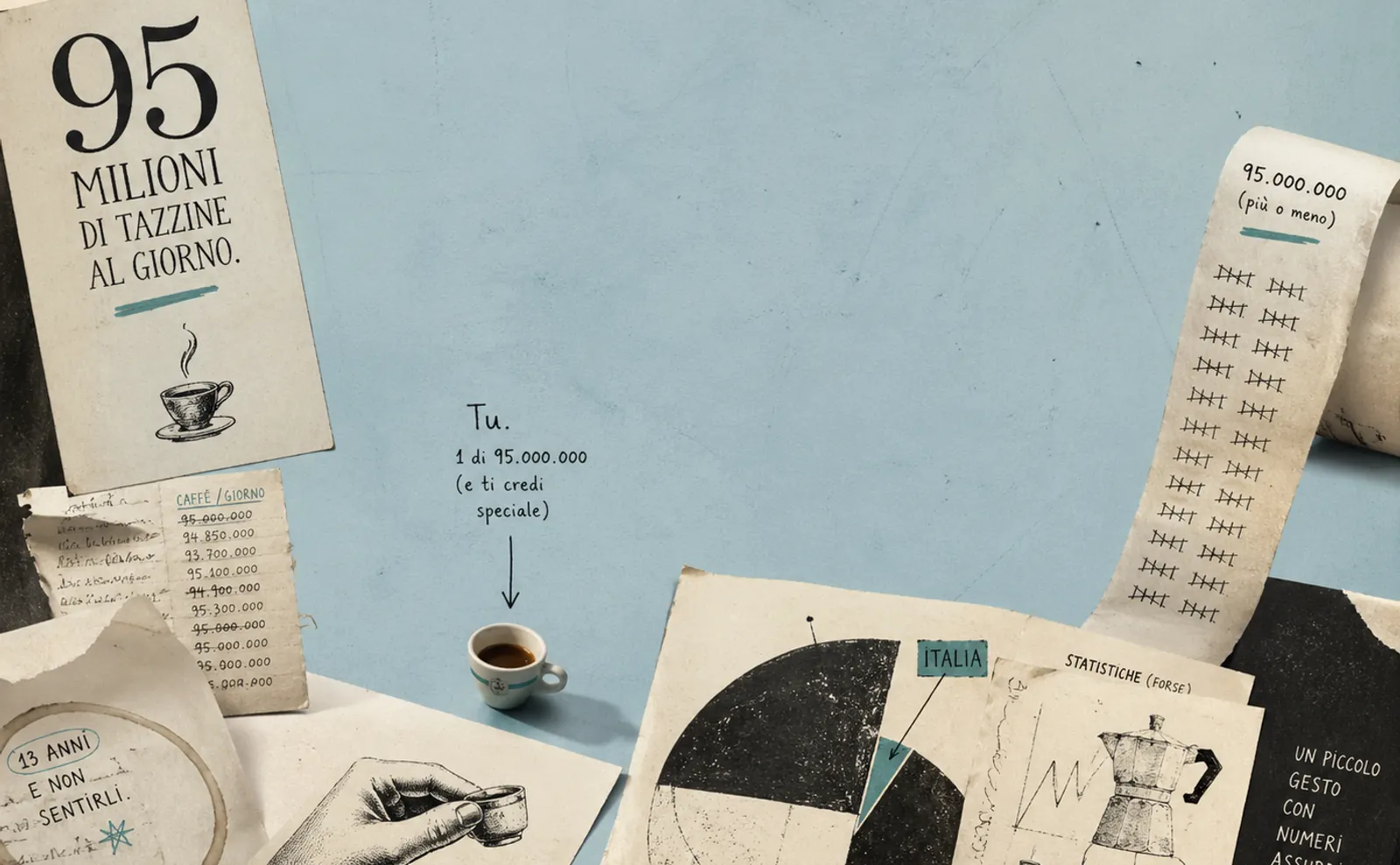 Data, but without sad Excel energy.
For people who like large numbers
The Italian coffee market is worth around 5.2 billion euros a year. The roasting industry includes roughly a thousand companies and more than seven thousand workers. Italy is the third largest importer of green coffee in the world, the second largest exporter within the EU and the largest European producer of roasted coffee.
In 2024, Italian coffee production passed 430,000 tons, worth about 4.7 billion euros. Green coffee mainly comes from Brazil, Vietnam, Uganda and India.
Then in 2025, coffee prices rose by 20.7% compared with the previous year. That is the kind of increase you usually see next to jewelry or energy bills. Consumption, however, does not really collapse. A ritual is a ritual, and Italians still go to the bar.
The ritual stays, the shape changes
In 2013 I wrote that in Sweden there is a habit called Fika, and that the word has a slightly different sound in Italian. That joke has not aged enough to be removed, so it stays.
What changed is how Italians drink coffee. Espresso at the counter is still central, but a lot is happening around it.
The capsule revolution. Almost one household in two now owns a capsule machine. Pods and capsules account for a smaller share of volume, but a much larger share of retail value, because the price per kilo is high enough to make ground coffee look modest. Traditional ground coffee is still strong, but the direction is visible.
The moka is not dead. If anything, it keeps returning. In a world of capsules and automatic machines, the moka carries a deliberate kind of nostalgia. Most Italians still like the moment when the coffee rises. It is hard to explain if you have not experienced it. It sits somewhere near rain on a metal roof and the smell of fresh bread.
Decaf. This surprised me. More and more people switch between regular coffee and decaf during the day, choosing caffeine according to rhythm rather than ideology. Experts call this the “Caffeine Conscious Generation”, which sounds like an indie band, but the idea is simple: people want coffee without surrendering the entire nervous system to it.
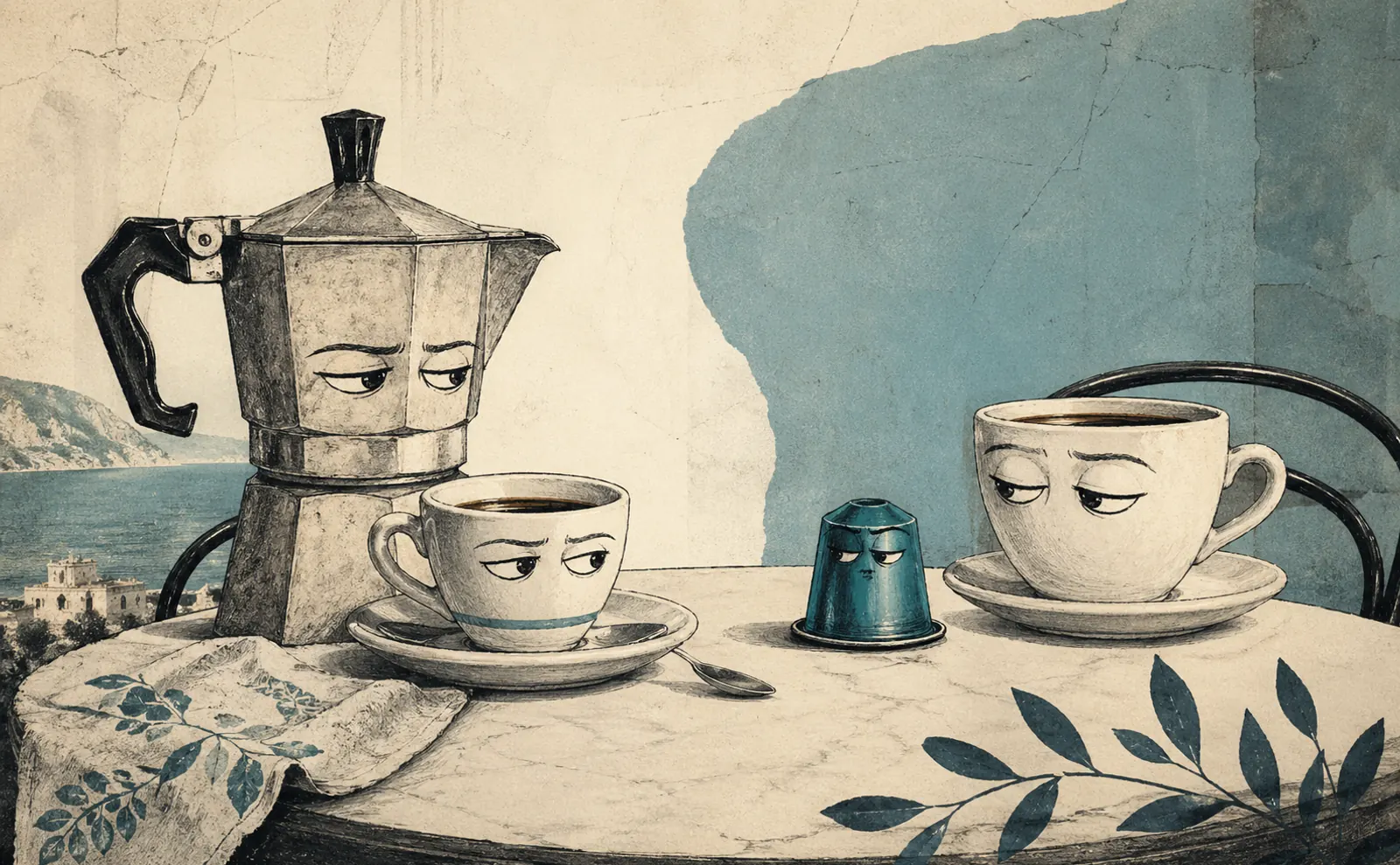 Tradition does not disappear. It sits down, watches and judges quietly.
Starbucks: the prediction was mostly right
In the old article I wrote that Starbucks had expanded through Europe and the world, but had not yet found a place in Italy. I left the good or bad of that to the reader.
Thirteen years later, update: Starbucks arrived. In September 2018, it opened the Reserve Roastery in Piazza Cordusio, Milan. Howard Schultz returned to Italy with a format inspired by the Milanese bars that had impressed him in the 1980s. History, with a little irony.
Italy did not become a Starbucks country. But Starbucks did not fail either. It adapted, chose symbolic places, and treated Italy less like a market to conquer and more like a ritual to negotiate with.
Which is probably the only way it could work here.
Specialty coffee entered the room
In 2013, specialty coffee in Italy was still a niche inside a niche. Today it is not mainstream, but it is visible.
There are coffee shops that talk about origin, processing, extraction and roast profiles without sounding like a secret society. There are roasters working seriously on traceability. There are people who know that acidity is not a defect, that bitterness is not destiny, and that “strong” is often just a way to avoid describing anything.
The strange thing is that Italy, which turned espresso into a cultural gesture, has had a complicated relationship with specialty coffee. We like coffee, but we also like the idea that we already know everything about it.
That is not always helpful.
Specialty coffee asks for attention. It asks you to taste before judging, to accept that a coffee can be fruity without being wrong, clear without being weak, light without being underdeveloped.
In other words, it asks the Italian coffee drinker to do something very difficult:
change opinion without feeling personally attacked.
From an article to a zine
The biggest difference between 2013 and now is not only what I know. It is what I ended up making.
Coffee Is Not Dead (Yet) was born as a printed zine, not as a content funnel dressed as a magazine. Paper, interviews, photos, words, some obsessions and the desire to talk about coffee without turning it into a performance.
I also wrote the project side of it in the zine.coffee case study: what had to work, what I built, and how to put a paper object online without turning it into a generic landing page.
That changed my relationship with the subject. Writing about coffee after making a physical object forces you to slow down. You cannot refresh paper. You cannot hide behind an update. If something is there, it stays there.
And maybe that is good.
Because coffee online can easily become noise: recipes, hacks, gear, rituals, opinions, arguments about grinders, people explaining water chemistry with the emotional intensity of a courtroom drama.
The zine tries to do something quieter.
Not simpler.
Quieter.
So, what remains?
Thirteen years later, I would not write that old article the same way.
I would check the numbers better. I would avoid a few easy claims. I would be more careful with the difference between tradition and habit, between taste and identity, between knowing something and having repeated it many times.
But I would keep the curiosity.
That was the good part.
The old article was the beginning of a path I did not know I was taking. It was superficial, yes, but it pointed toward something real. Sometimes that is enough. You start with a small curiosity, then years later you find yourself discussing roast profiles, editing a zine and pretending the raised pinky is ironic.
Mostly ironic.
Coffee has changed. Italy has changed a little. I have changed a lot.
The cup is still there.
Only now, before drinking, I look at it for slightly longer.