On November 1, 2012, Gae Aulenti, the lady of architecture, passed away.
Architect, designer, stage designer, creator of places and objects that did not need to raise their voice to stay in memory. One of those figures who crossed the twentieth century without asking too much permission, leaving traces in cities, museums, theatres, lamps, tables with wheels and squares everyone knows, even when they do not know who designed them.
This article began as a small tribute. I keep it that way: not a definitive biography, more a note to remember someone who worked on space with rare clarity.
The lady of architecture
“Architecture is a man’s profession, but I always pretended not to notice.”
Born in Palazzolo dello Stella on December 4, 1927, Gae Aulenti was often called “the lady of architecture”, but in the world of architecture and design she was simply Gae.
That already says something. Some people need a full title. Some need only a surname. A few need only a first name.
To Milan and back
Her first important work was for Olivetti, together with Giorgio Soavi: first the Paris showroom, then Buenos Aires.
From there began a life made of departures, returns, projects and cities. Milan remained a center, but never a border.
Her signature appears in the renovation of Palazzo Grassi, the project for Piazzale Cadorna in Milan, the installation of the Musee d’Orsay in Paris, the Museu Nacional d’Art de Catalunya in Barcelona and the Asian Art Museum in San Francisco.
Basically, the kind of career that makes you want to sit down after reading it. Preferably on a well-designed chair.
Space, theatre and context
Gae Aulenti was not only an architect and designer. She also worked as a stage designer and collaborated with Luca Ronconi on exhibitions, installations and theatre projects, including early stage work in Naples in 1974.
“Working for theatre made me understand the value of action in architecture: even in the Musee d’Orsay installation, the idea of action enters through paths, passages from one space to another, avenues. An idea of time, not only space.”
That sentence says a lot about her work.
For Aulenti, architecture was never just form. It was movement, reading, sequence, friction between what already exists and what is added.
She did not erase places in order to make them hers.
She listened to them, then transformed them.
Objects that stayed
Many people know Gae Aulenti through objects rather than buildings.
The Pipistrello lamp for Martinelli Luce is probably the most famous: halfway between domestic object and small creature, elegant without being too polite.
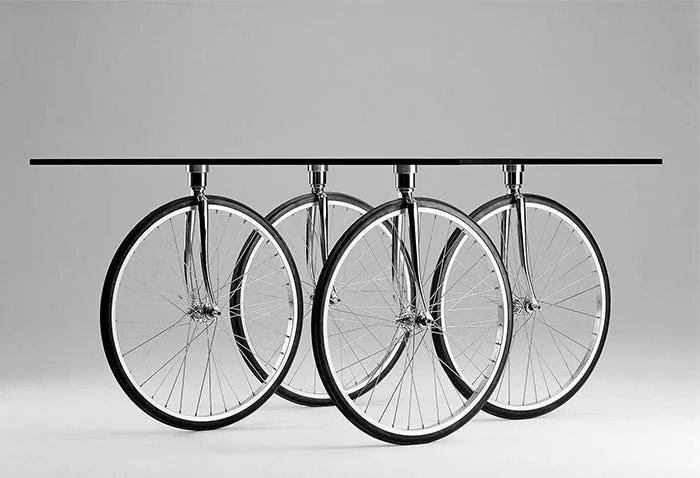
Then there is the Tour Table for FontanaArte, with its glass top and bicycle wheels. It is one of those objects that should not work and instead works precisely because it keeps a little absurdity alive.
If you like looking at objects through context rather than name-dropping, there is also the piece on seven design chairs for our home.
That is one of the things I like about her work: it can be serious without becoming stiff.
She understood institutions, museums, urban spaces, but she also knew that an object can carry irony, movement, a small displacement of expectation.
Why she still matters
Gae Aulenti matters because she did not reduce design to style.
Her projects are not interesting only because they are beautiful, famous or historically important. They are interesting because they show a way of working: reading the existing context, understanding its memory, then adding something strong enough to be present and careful enough not to flatten everything around it.
That balance is rare.
Especially now, when many projects seem more concerned with looking immediately recognizable than with understanding where they are.
Aulenti belonged to another kind of intelligence.
Not nostalgic.
Not decorative.
Contextual.
The kind that knows a place is never an empty page.