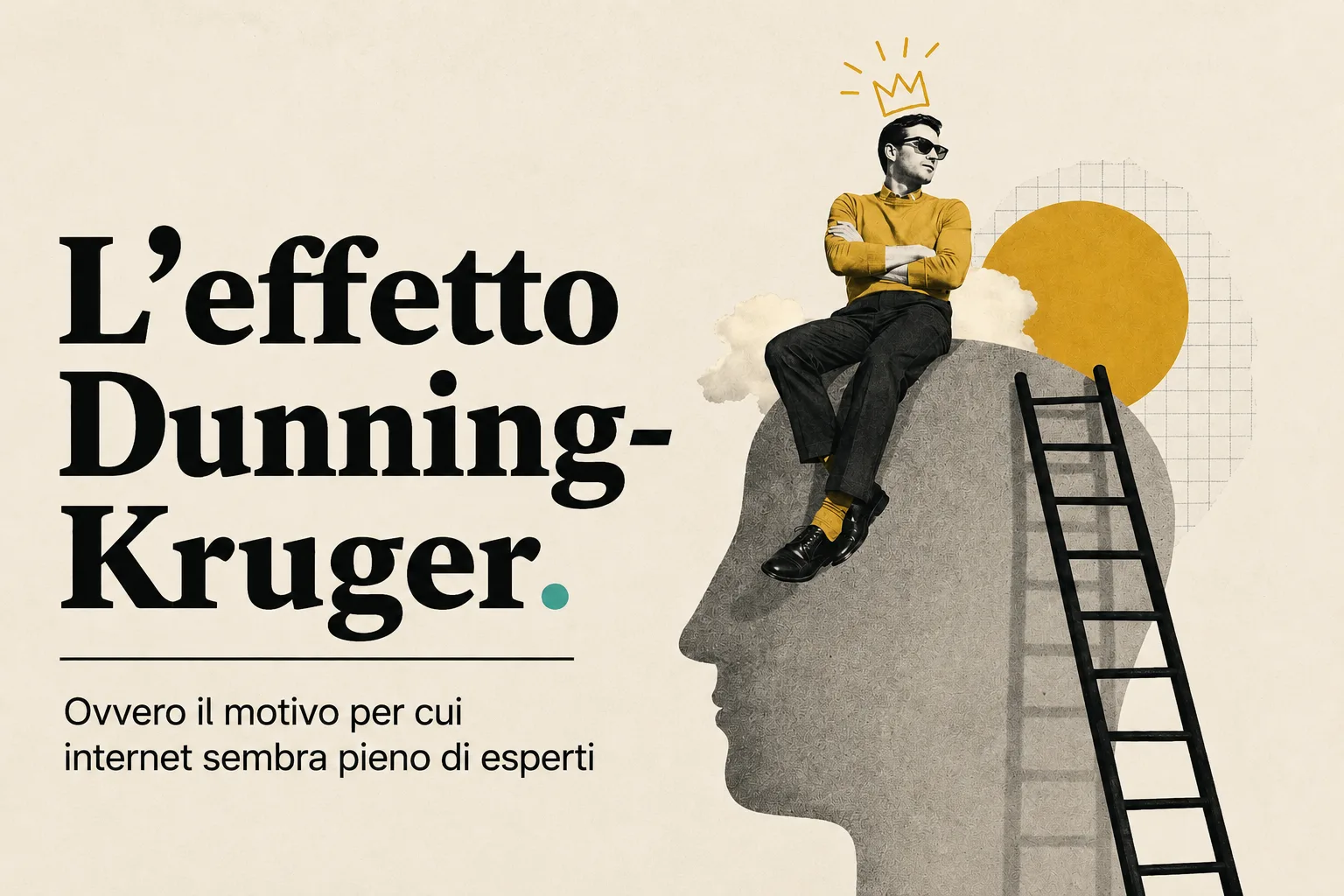
In January 1995, a man named McArthur Wheeler walked into two banks in Pittsburgh, armed, in broad daylight, with no mask, no hood and no disguise of any kind.
Instead of a mask, he had used lemon juice, carefully spread over his face, because lemon juice can be used to make invisible ink and, following a line of reasoning that must have felt perfectly reasonable inside his head, if it can make ink invisible, maybe it can make a face invisible too.
The best part is that Wheeler had even tested the theory before the robberies. He took a Polaroid of himself to check the result. His face did not appear clearly in the picture, probably because of exposure or simply because he had framed it badly, but for him that was the final confirmation.
He walked into the banks smiling at the cameras, and was arrested a few hours later.
When the police showed him the security footage, he was genuinely surprised and reportedly said:
“But I wore the juice.”
That sentence is incredible not only because it is absurd, but because it says something deeply human.
Not stupidity, which is the simplified version the internet likes to use in order to feel superior to other people.
The interesting part is something else: Wheeler was not pretending. He did not feel like a criminal genius. He was convinced he had understood something, and above all he did not have the tools to notice that his reasoning was falling apart.
That is where, a few years later, what we now call the Dunning-Kruger effect begins to take shape.
Where the effect really comes from
In 1999, psychologists David Dunning and Justin Kruger published a paper with a fairly direct title: Unskilled and Unaware of It.
The idea was simple and almost cruel in its elegance: people with lower competence often tend to overestimate their ability because the skills needed to do something well are, very often, the same skills needed to understand how badly we are doing it.
Less academically: if you know very little about a subject, you may also know too little to realize how little you know.
This is much more common than it sounds.
It happens with personal finance, nutrition, specialty coffee, photography, artificial intelligence, geopolitics, bonsai and probably with any discipline complex enough to look simple from the outside.
And this is where the internet makes everything worse.
The internet rewards confidence, not competence

Online, confidence is easily mistaken for authority.
Often, it is the only thing that really counts.
Someone saying:
“The issue is more complicated than that.”
will almost always get less attention than someone saying:
“Let me explain how it really works.”
The second person sounds more competent, clearer, more credible.
Spoiler: not necessarily.
Social platforms amplify this almost perfectly. The more something is explained with certainty and simplicity, the more true it appears. And the more complex the topic is, the more dangerous that simplification becomes.
That is one reason why we now have:
- AI gurus who seem to have been born roughly three weeks ago
- investors who became experts during a bull market
- people who read half a Reddit thread and suddenly “did the research”
- creators explaining enormous topics in 40 seconds with a ring light and a very confident thumbnail
The problem is that, at the beginning, learning something gives you a powerful feeling of understanding.
You discover a few concepts, learn the right vocabulary, start recognizing patterns, and your brain reads that familiarity as real competence.
It feels wonderful, and it is also a trap.
The graph everyone knows and that does not exist
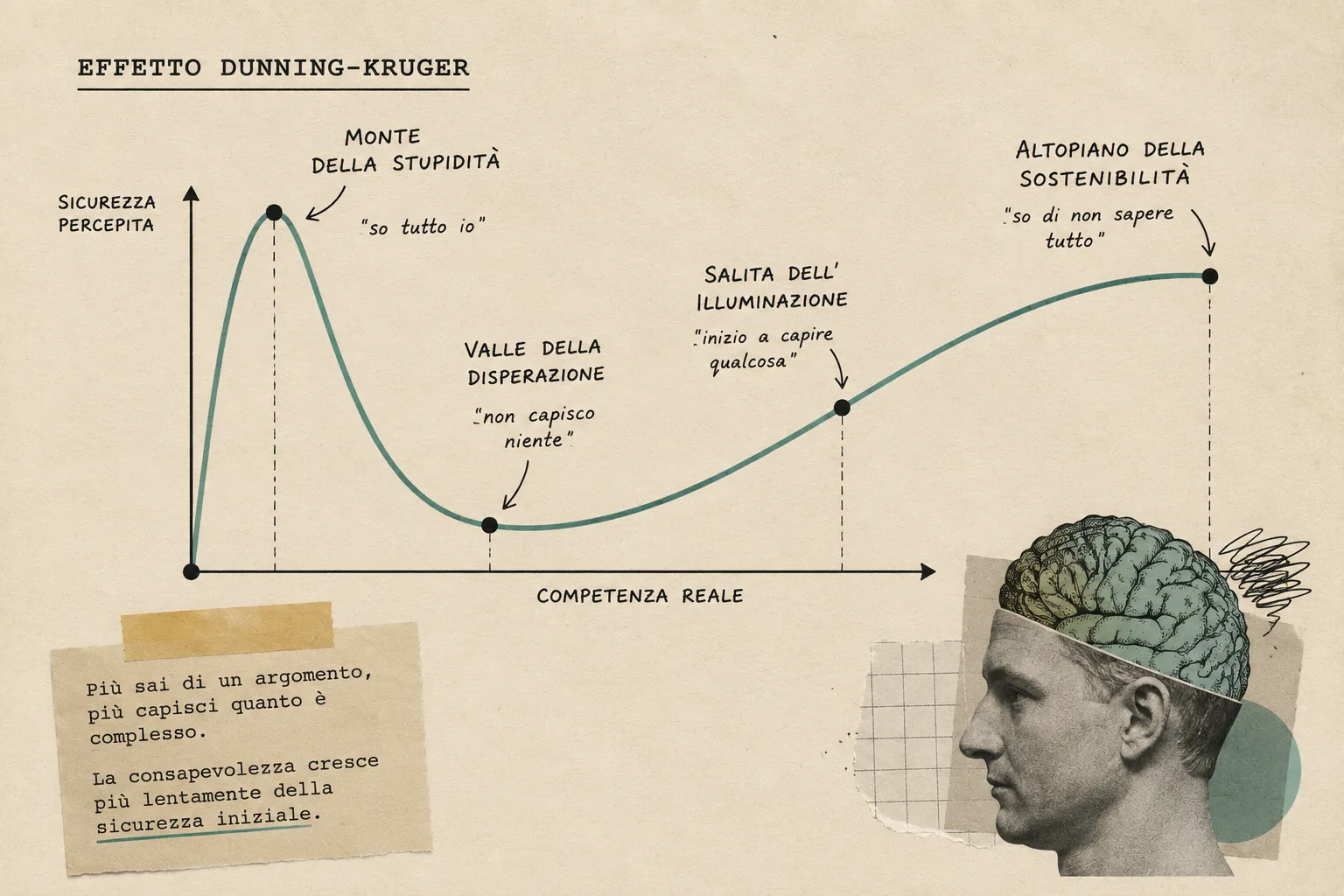
If you have heard about Dunning-Kruger online, you have probably seen the graph.
The one with the “Mount Stupid”, the “Valley of Despair” and the slow climb toward some kind of final cognitive enlightenment.
There is only one small detail.
That graph does not appear in the original study.
Dunning and Kruger never talked about mountains, valleys or heroic journeys of self-awareness. The real graph was much more boring, much more academic and much less shareable on LinkedIn.
The “Mount Stupid” came later, probably from the internet itself, and became popular because it tells a story we like very much: other people are arrogant and incompetent, while we are the aware, balanced, sophisticated ones.
Which is already quite ironic, because the way the web simplified Dunning-Kruger is probably one of the best examples of Dunning-Kruger applied to Dunning-Kruger.
The part almost everyone ignores
The pop version of the effect says:
“Stupid people do not know they are stupid.”
But that is not really the point.
The original study was about specific skills in specific contexts. Not general intelligence. A surgeon can be brilliant in an operating room and completely disastrous when talking about design, miso fermentation or macroeconomics.
And of course the opposite is also true.
There is another detail that is mentioned much less often: the more competent people tended to slightly underestimate themselves.
Not because of false modesty, but because they saw more complexity, more variables, more exceptions.
Anyone who goes deeply into something rarely keeps perceiving it as simple.
It is one of the most recognizable transformations in any serious discipline.
At the beginning everything looks clear, then you actually start studying and suddenly entire levels appear that you could not even see before.
The more you learn, the larger the territory becomes.
Maybe we oversimplified this too

In recent years, some researchers have criticized parts of the original conclusions, arguing that the phenomenon has been described too absolutely and, in some cases, amplified by the way the data was interpreted.
And that is almost poetic.
Even Dunning-Kruger may have become a victim of its own simplification.
Which is exactly the kind of irony the internet produces when it takes a complex idea, turns it into a meme and then uses it to explain everything from flat-earthers to comments under a nutrition reel.
The truth is probably less spectacular and much more human: we all overestimate something, and we all have areas where we know enough to feel confident, but not enough to see what we are missing.
Maybe that is inevitable.
Maybe it is also necessary.
If we could immediately perceive the full complexity of a discipline, many people would never start anything at all.
The point is not becoming insecure
I think the most useful part of the Dunning-Kruger effect is not learning to distrust other people.
That is easy.
The useful part is developing a small internal friction when we feel too sure too soon.
Real competence rarely looks like omniscience. More often, it looks like someone who has seen enough complexity to stop speaking in absolutes.
That is not weakness.
It is not indecision.
It is simply what happens when you start to understand how easy it is to confuse familiarity, vocabulary and confidence with real understanding.
And that difference is enormous.
Maybe it is also one of the few antidotes left in a time where everyone has to look immediately expert at something, preferably in front of a 4K camera and with a title like:
“The truth no one tells you.”
Which is usually a very good moment to start doubting.
And if, after all this, you feel pretty sure you have completely understood the Dunning-Kruger effect, maybe it is worth asking one more question.